Friday, October 5, 2012

1.7 Million Gallons of Toxic Oil and Gas Liquids Unrecovered in Weld County Colorado


.........................................................................


February 27, 2012

Ms. Tisha Schuller
Colorado Oil and Gas Association
1660 Lincoln Street, Suite 2710
Denver, CO  80264

Dear Ms. Schuller,

It has recently come to our attention that your Association has paid for and is airing a radio advertisement about drilling and fracking in Colorado.  The ad is here: http://www.coga.org/audio/Gov_Hickenlooper_HF_Rule_30sec.mp3

This ad contains this sentence:  “Since then [2008] we have not had one instance of groundwater contamination association with drilling and hydraulic fracturing.” 

This sentence is not correct.

Specifically, our organizations have analyzed the 615 “Incident Spill Reports” for oil and gas drilling and fracking reported to the Colorado Oil and Gas Conservation Commission (COGCC) in just one Colorado County (Weld) from 1/3/2008 – 1/5/2012.  These publicly searchable reports (Table 1 below)available on COGCC’s website reveal that:


1.      44% of spills have contaminated groundwater.
2.      2.8% of spills have contaminated surface water.
3.      40% of spills have resulted in or been caused by berm failures.

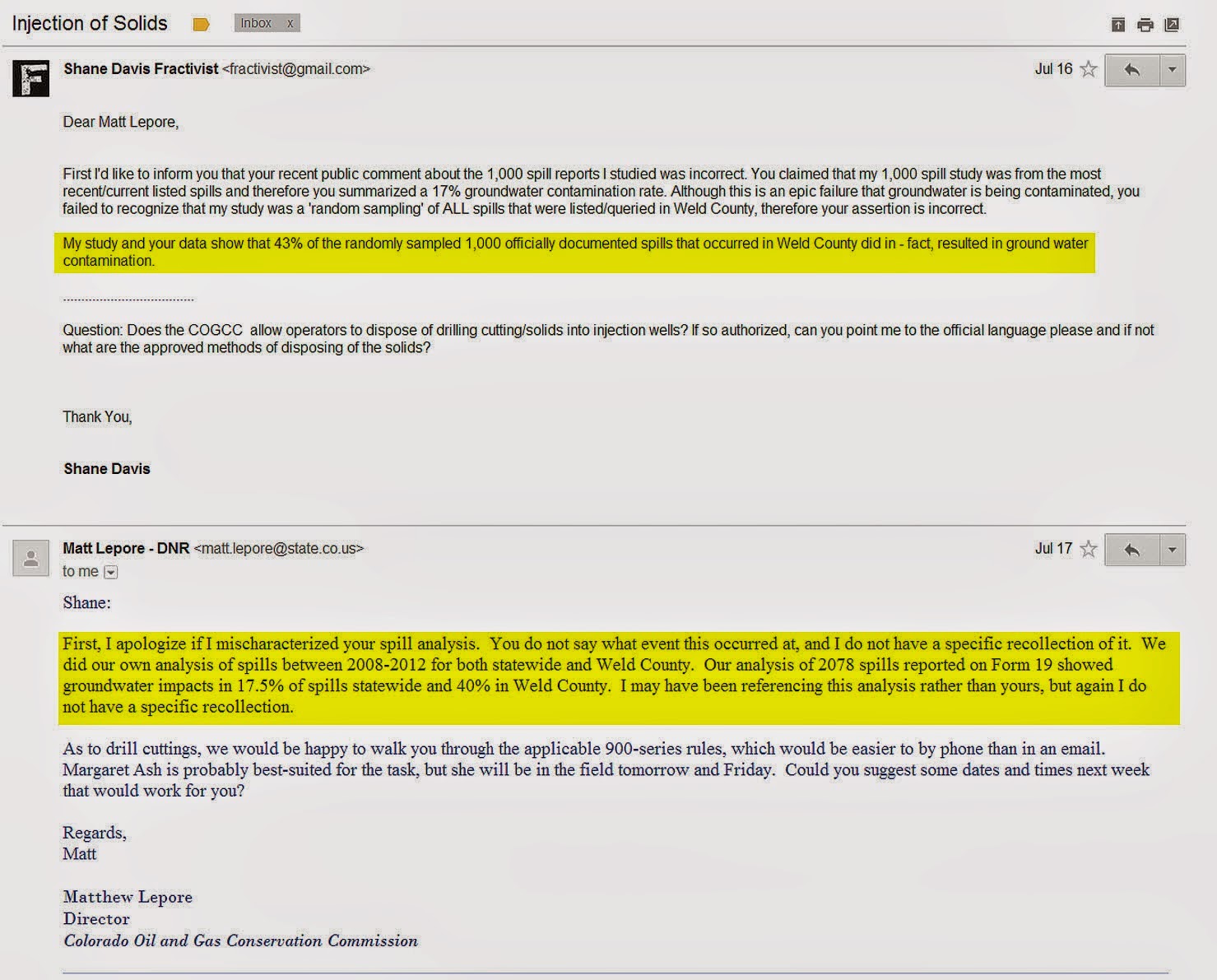
Further, we have also reviewed the 1,000 Incident Spill Reports available on COGCC’s website for Weld County, dated 8/28/2003 – 1/05/2012 (the COGCC website only lists the 1,000 most recent reports).  Those reports (table 2 below) reveal that:

1.      43% of spills have contaminated groundwater.
2.      3.1% of spills have contaminated surface water.
3.      43% of spills have resulted in or been caused by berm failures.

These reports are available for each the 40 oil and gas companies operating in Weld County, revealing that bulk of the spills and contamination are due to a handful of companies.

Further yet, we randomly sampled 60 of the 1,000 Spill Incident Reports and extrapolated those results to generate an estimate of fluid contamination.  Those results (Table 3 below) reveal that:

1.      Up to 824,600 gallons of oil have been spilled and “unrecovered” in Weld County.
2.      Up to 383,600 gallons of produced water has been spilled and “unrecovered” in Weld County.
3.      Up to 547,400 gallons of “Other” fluid has been spilled and “unrecovered in Weld County.  (“Other” may include fracking fluids.)

The results above are just for one County, Weld, and do not reflect spills and groundwater contamination in the 41 other Colorado counties in which oil and gas drilling and fracking occur. 
Because the statement in your radio ad is incorrect, we request that you correct the ad or remove it from the airwaves.

Respectfully,

Shane Davis, Chair, Poudre Canyon Group of the Sierra Club, shane.davis@rmc.sierraclub.org, 509-570-4422

Gary Wockner, PhD, Colorado Program Director, Clean Water Action, gwockner@cleanwater.org, 970-218-8310


1/3/2008 - 1/5/2012
271 YES
17 YES
246 YES
344 NO
598 NO
369 NO
GW CONTAM
44.0%
YES
GW CONTAM
56.0%
NO
SURFACE H2O CONTAM
2.8%
YES
SURFACE H2O CONTAM
97.2%
NO
BERM CONTAINED
40.0%
YES
BERM CONTAINED
60.0%
NO

Table 1
INCIDENT SPILL REPORTS
271 YES
17 YES
246 YES
2008
GW CONTAM
44.0%
YES
GW CONTAM
56.0%
NO
SURFACE H2O CONTAM
2.8%
YES
SURFACE H2O CONTAM
97.2%
NO
BERM CONTAINED
40.0%
YES
BERM CONTAINED
60.0%
NO


Table 2:
Company Name
Ground Water
Surface Water
Berm Contained
TOTAL 1000 SPILL INCIDENT REPORTS
427 YES
31 YES
429 YES
40 OPERATORS –WELD COUNTY
563 NO
969 NO
571 NO


TOTAL PERCENTAGE FROM 1000 SPILL REPORTS
GW CONTAM
42.7%
YES

GW CONTAM
56.3%
NO


SURFACE H2O CONTAM
3.1%
YES

SURFACE H2O CONTAM
96.9%
NO


BERM CONTAINED
42.9%
YES

BERM CONTAINED
57.1%
NO


Company Name
Ground Water Contamination
Surface Water Contamination
Berm Not Contained
BAYSWATER EXPL AND PROD LLC   * 1 reported
0.0%
0.0%
100.0%
BLUE CHIP  * 2 reported
50.0%
0.0%
100.0%
BONANZA CREEK  * 21 reported  
16.0%
11.0%
63%
CDM  * 1 reported
0.0%
100.0%
100%
CHESAPEAKE  * 4 reported
0.0%
0.0%
0%
COLTON  * 1 reported
0.0%
0.0%
0.0%
CONQUEST  * 5 reported
0.0%
0.0%
20.0%
DIAMOND  * 1 reported
0.0%
0.0%
100.0%
DUKE  * 1 reported
0.0%
0.0%
100.0%
EDDY  * 3 reported
67.0%
0.0%
100.0%
ENCANA  * 46 reported
44.0%
4.0%
61.0%
ENERVEST  * 1 reported
0.0%
0.0%
100.0%
EOG  * 4 reported
0.0%
0.0%
0.0%
FOUNDATION  * 1 reported
0.0%
0.0%
0.0%
FOUNTAINHEAD  * 3 reported
100.0%
0.0%
34.0%
GREAT WESTERN  * 2 reported
0.0%
0.0%
50.0%
GRYNBERG  * 3 reported
0.0%
0.0%
34.0%
HIGH PLAINS DISPOSAL  * 1 reported
0.0%
0.0%
0.0%
HYNDREX  * 1 reported
0.0%
0.0%
100.0%
KP KAUFMAN  * 23 reported
13.0%
30.0%
91.0%
KERR MCGEE  * 391 reported
59.0%
2.0%
47.0%
LONE STAR  * 1 reported
0.0%
0.0%
100.0%
MACHII   * 6 reported
17.0%
17.0%
100.0%
MATRIX  * 2 reported
50.0%
0.0%
0.0%
MERIT  *15 reported
20.0%
0.0%
47.0%
MINERAL  * 1 reported
0.0%
0.0%
0.0%
MONAHAN  *3 reported
0.0%
0.0%
67.0%
NOBLE  * 236 reported
31.0%
2.0%
69.0%
PATINA  * 20 reported
30.0%
0.0%
30.0%
PETRO CANADA  *29 reported
45.0%
0.0%
62.0%
PETROLEUM DEVELOPMENT  *158 reported
47.0%
3.0%
67.0%
PRIMA  * 1 reported
0.0%
0.0%
0.0%
RED WILLOW  * 3 reported
0.0%
0.0%
33.0%
STARLIGHT  * 3 reported
0.0%
0.0%
0.0%
SYNERGY  * 2 reported
0.0%
0.0%
0.0%
TEXAS AMERICAN RESOURCES *2 reported
0.0%
0.0%
100.0%
TOP OPERATORS * 1 reported
0.0%
0.0%
100.0%
US EXPLORATION  * 1 reported
0.0%
0.0%
0.0%
WALSH PRODUCTIONS  * 1 reported
0.0%
0.0%
0.0%
WINDSOR  * 1 reported
0.0%
0.0%
0.0%


Weld County “Spill Release Reports" (08/28/2003 - 01/05/2012)

60 Randomly Picked
If 60 statistically represent 1,000, estimated
Estimated Unrecovered Fluid (1,000 reports) 
Spill Area (square feet)
146,717,366
2,445,289,440

Oil Spilled (gal)
65,646
1,094,100

Oil Unrecovered (gal)
49,476
824,600
824,600
Produced Water Spilled (gal)
31,164
519,400

Produced Water Unrecovered (gal)
23,016
383,600
383,600
Other Spilled (gal)
34,104
568,400

Other Unrecovered (gal)
32,844
547,400
547,400
Total Estimated Unrecovered Fluid (gal)


1,755,600

Wednesday, September 26, 2012

FRACK FREE COLORADO FREE CONCERT - WALLFLOWERS RAMI JAFFEE & MORE


Inadequate enforcement means current Colorado oil and gas development is irresponsible


LINK


Promised Land TRAILER (2012) - Matt Damon Fracking Movie

Clean Water Action delivers 1,000 hand-signed postcards to Governor Hickenlooper


For Immediate Release
September 26, 2012
Clean Water Action, Gary Wockner, 970-218-8310

Clean Water Action delivers 1,000 hand-signed postcards from Denver metro residents asking Governor Hickenlooper to increase drilling/fracking setbacks.

Denver, CO – On Wednesday September 26th, Clean Water Action delivered 1,000 postcards to the Office of the Governor that were hand-signed by residents in the Denver metro area urging Governor Hickenlooper to take action and support a significant increase in the distance drilling and fracking sites can be from homes, schools, and hospitals. Clean Water Action’s canvassing program has been knocking on doors throughout the metro area over the last 6 weeks, educating citizens at the door and helping them take action.

“Current setback standards of 350 feet in densely populated areas are not far enough to protect our air, water, and communities,” said Gary Wockner of Clean Water Action.  “The public’s health and property values are increasingly at risk as drilling encroaches on suburban Colorado.”

The Colorado School of Public Health published a study indicating that cancer causing air emissions from drill sites may cause health impacts up to a half mile from a drill site, which is a 7.5 times greater distance than current Colorado setbacks law requires. 

The Colorado Oil and Gas Conservation Commission (COGCC) has convened a “Setback Stakeholder Group” made up of local governments, environmental groups, individuals, and COGCC staff.  

“We want to see some real leadership from Governor Hickenlooper on this issue,” said Gary Wockner. “Coloradans deserve to have their community’s health, property values, quality of life, and safety protected when a new rulemaking process moves forward about setbacks.”


-end-

Tuesday, September 18, 2012

*FOR IMMEDIATE RELEASE* SIERRA CLUB AND 12 OTHER ORGANIZATIONS DEMAND IMMEDIATE CLOSURE OF THE COGCC SETBACK LOOPHOLE


FOR IMMEDIATE RELEASE
September 18, 2012


Sierra Club and coalition demand closing hazardous oil & gas drilling setback loophole


Contacts:             Shane Davis, Sierra Club Oil & Gas Team, 509.570.4422
                              Joshua Ruschhaupt, Sierra Club RMC Director, 303.454.3362

Denver, CO – Friday, Sierra Club Rocky Mountain Chapter and 12 other groups asked the Colorado Oil and Gas Conservation Commission to immediately address, and close its existing “Setback Loophole.”  In addition the minimum setback standards need to be significantly expanded.  Sign-on letter attached below.

This Setback Loophole allows any “completed” well to be re-entered and re-drilled regardless of proximity to a structure. There are approximately 4,000 active oil and gas wells that are closer to residential structures than the COGCC setback mandate of 350’. There are also approximately 82,000 abandoned wells in Colorado, and early statistics show that approximately 55% of abandoned wells are being re-entered and re-drilled, meaning there could eventually be tens of thousands of wells closer to residential structures than the current setback mandates. The Setback Loophole denies the COGCC the power to prevent and mitigate adverse environmental and human health impacts

In addition, the current minimum drilling setback standards are far short (350’ urban, 150’ rural) of needed protections, and the Sierra Club RMC and coalition signers of this letter to the COGCC request a minimum of 2,000’ plus 100’ for each additional well bore, due to the concentration of on-site emissions from aggregated wellbores.


###

About The Sierra Club
The Sierra Club is America’s largest and most influential grassroots environmental organization with more than 1.4 million members and supporters nationwide.  In addition to creating opportunities for people of all ages, levels and locations to have meaningful outdoor experiences, the Sierra Club works to safeguard the health of our communities, protect wildlife, and preserve our remaining wild places through grassroots activism, public education, lobbying and litigation. For more information, visit http://www.sierraclub.org.

Sierra ClubSierra Club Rocky Mountain Chapter
1536 Wynkoop St., 4B-1
Denver, CO 80202


A copy of the letter submitted to the COGCC:

Matthew Lepore
Colorado Oil and Gas Conservation Commission
1120 Lincoln Street, Suite 801
Denver, Colorado 80203

September 14, 2012

Dear Mr. Lepore,

The Sierra Club Rocky Mountain Chapter requests that the State begin a rulemaking process for increasing minimum setbacks for oil and gas drilling to 2,000 feet plus an additional 100 feet per additional onsite wellbore near residences, schools, playgrounds/sports fields/parks, hospitals, nursing homes, and other similar facilities, due to the concentration of on-site emissions from aggregated wellbores. Current state regulations mandate a minimum setback distance of just 350 feet in all urban settings.

The Sierra Club believes that the protection of human life, public welfare, and the environment are essential factors to be considered by all levels of government when making siting decisions. We believe that land use planning should include in the siting decisions the protection of air and water quality, and public welfare. Such facilities should be excluded from certain categories of land zoning, and should proceed only after a need for them has been demonstrated. [http://sierraclub.org/policy/conservation/energyfac.aspx]

This request for a rulemaking addresses probable adverse impacts to the environment and human health from oil and natural gas development that uses hydraulic fracturing (“fracking”). The COGCC setbacks are not based on health impact studies, and no apparent scientific data support the COGCC’s claim that the current setbacks prevent or mitigate adverse impacts.

Setback Loophole
In addition, there is a “Setback Loophole” in the COGCC 600 Series Rules. Rule 603(a) lays out setbacks from various types of development; for example, wells must be sited at least 150 feet from property lines in rural areas, and 350 feet from high density structures. However, Rule 602(d) states: “Existing ‘completed’ wells are exempt from the provisions of these regulations as they relate to the location of the well.”

This Setback Loophole allows any ‘completed’ well to be re-entered and re-drilled regardless of proximity to a structure. There are approximately 4,000 active oil and gas wells that are closer to residential structures than the COGCC setback mandate of 350’. There are also approximately 82,000 abandoned wells in Colorado, and early statistics show that approximately 55% of abandoned wells are being re-entered and re-drilled, meaning there could eventually be tens of thousands of wells closer to residential structures than the current setback mandates. The Setback Loophole denies the COGCC the power to prevent and mitigate adverse environmental and human health impacts.

It is urgent that the COGCC fully address and update the current inadequate setbacks, for oil and gas development near high density residential areas, including, but not limited to: hospitals, public schools, buildings and grounds, parks, playgrounds, and other areas of special concern.   We request that the Setback Loophole allowing for oil & gas activities be closed, and that the COGCC abide by its mission to prevent and mitigate adverse environmental impacts, which also  impact human health and welfare.

Protecting Water Quality
Northern Colorado is in the midst of an unprecedented increase in oil and gas drilling, including fracking, taking place near densely-populated residential areas. A recent analysis by Sierra Club and Clean Water Action found that 44% of all operator spills have caused and are continuing to cause groundwater contamination. 3.1% have caused surface water contamination and 57% of protective berms failed to prevent secondary fluid migrations.
[http://www.cleanwateraction.org/files/publications/co/SC-CWA-to-COGA-2-27-2012.pdf]

Since the 2008 COGCC Rule change, ground water contaminations have risen by 3.5% and berm failures increased by 3% to 60% of all berms having failed to prevent secondary fluid migration.

The Sierra Club has identified fracking and its associated impacts as the issue of utmost concern in Colorado, and EPA studies are needed to identify a wide range of potential adverse impacts on human health, and until such studies are completed, we should proceed with utmost caution in exposing our communities to unknown and possibly dangerous impacts.

Protecting Air Quality
Both science and experience in Colorado establish that the COGCC should adhere to its statutory mandate of protecting human health in the conduct of oil and gas operations by 1) minimizing fugitive emissions and other toxic chemicals, and 2) maximizing the distance of natural gas facilities from residences and other public places based on the good science of sound health impact assessments.  These two principles should guide state policy on oil and gas activities in populated areas.

We are respectfully requesting that the state of Colorado recognize the continuing weaknesses in “the strongest regulations in the Country,” as is often quoted in the media, and continue to lead the country with improvements that show Coloradans that the COGCC is addressing their concerns swiftly and comprehensively.  This is an industry that appears to know no boundaries when it comes to the average citizen looking out of their home windows.  We need the COGCC to be responsive and pro-active with regard to protecting the environment Coloradans depend upon for our lifestyle, quality of living, health, and welfare.

Studies linking oil and gas development to water contamination can be found at the following links:


For a complete listing of Sierra Club policies as they relate to this industry, see: http://goo.gl/A5nCA

Sincerely,


Shane Davis
Oil & Gas Team Research & Information Manager
Sierra Club Rocky Mountain Chapter


Joshua Ruschhaupt
Director
Sierra Club Rocky Mountain Chapter
1536 Wynkoop St., 4B-1
Denver, CO 80202
303.454.3362

Additional signing organizations:


Dr. Gary Wockner
Colorado Program Advisor
Clean Water Action
1536 Wynkoop Street, Suite B-400
Denver, CO 80202
303.405.6755
http://www.cleanwateraction.org/co

Shane Davis
Director
Fractivist.com
PO BOX 576
Longmont, CO 80502
509.570.4422
http://www.fractivist.com

Jennifer Palazzolo
Co-Founder
Erie Rising
2770 Arapahoe Suite 222
Lafayette, CO 80026
720.839.9097
http://www.erierising.com

Claudette Konola
Western Colorado Congress Mesa Cnty
Mesa County WCC
PO Box 1931
Grand Junction, CO 81502
http://wccmesa.org/

Christine Canaly
Director
San Luis Valley Ecosystem Council
P.O. Box 223
Alamosa, CO 81101
(719) 589-1518 (office)
(719) 256-4758 (hm office)
slvwater@fairpoint.net
slvec.org

Jodee Brekee
Commerce City Unite NOW
Adams County Unite NOW
106th Ave
Commerce City
303.591.5721

Eleanor J. Jefferson
Lakewood Fracktivists
640 S, Vance St,
Lakewood,CO 80226
720-261-6615

Rico Moore
Fort Collins Citizens for Health and the Environment
The Cache la Poudre River Foundation
721 West Myrtle Street
Fort Collins, CO 80521

Kim Orr
Co-Founder
Loveland Rising
march.hare.house@gmail.com

Sloan Shoemaker
Executive Director
Wilderness Workshop
PO Box 1442
Carbondale, CO 81623
970-963-3977
sloan@wildernessworkshop.org
www.wildernessworkshop.org

Jim Ramey, Director
Citizens for a Healthy Community
chc.director@gmail.com
P.O. Box 291
Hotchkiss, Colorado 81419
970. 527.7779
www.citizensforahealthycommunity.org

Roz McClellan
Rocky Mountain Recreation Initiative
1567 Twin Sisters Rd.
Nederland, CO 80466
303.447.9409, 720.635.7799


Saturday, September 15, 2012

Sierra Club Releases New Report Highlighting Attack on Clean Energy


“Clean Energy Under Siege” Study Follows Money Trail Behind Campaign Against Renewable Energy 


WASHINGTON D.C. – Over the past decade, the fossil fuel industry has mounted a coordinated campaign to discredit renewable energy and hinder its growth, according to a new report released today by the Sierra Club.

The report, Clean Energy Under Siege, reveals how the fossil fuel industry is using tactics such as financial contributions to political campaigns, faux “think tanks,” phony intellectuals, and astroturf groups to shift public opinion and discredit renewable energy.

This misinformation campaign is currently evident in the struggle to renew the Production Tax Credit (PTC) for wind energy. The PTC helps support the more than 75,000 jobs in the wind industry, but if the tax credit is not renewed before the end of this year, as many as half those jobs could be lost.

"From California to Pennsylvania, clean energy jobs are under attack by fossil fuel interest groups – yet many in Congress are sitting on their hands while tens of thousands of American jobs hang in the balance," said Michael Brune, executive director of the Sierra Club. "It seems these members of Congress prefer serving the interests of the big polluters that bankrolled their campaigns over the interests of working families. That needs to end now. Congress must stand up for the tens of thousands of Americans whose jobs are on the line and renew the Production Tax Credit."

The Sierra Club’s report follows the trail of money from big polluters to politicians and non-profit front groups. For example, the oil and gas industry spent more than $146 million on lobbying alone in 2011, while Big Oil tycoons David and Charles Koch gave at least $85 million to 85 right-wing “think tanks” and advocacy groups over the past decade and a half. Meanwhile, organizations like the Manhattan Institute and the Heartland Institute that defend oil subsidies while attacking renewable energy have received upwards of $600,000 each since 1998 from the oil company Exxon.

Wind power is a clean, competitive energy source that has seen strong momentum over the past few years. Already, states like Iowa and South Dakota generate 20 percent of their electricity from wind power, and the wind industry is on track to produce 20 percent of America’s electricity by 2030. More than 400 American manufacturing plants build wind components, keeping jobs close to home.


Please Donate Today!