Showing posts with label Encana. Show all posts

Saturday, December 9, 2017

Were Seismic Operations Illegally Conducted by the Oil and Gas Industry in Boulder County? Supporting Documents May Reveal Answers

It appears three oil and gas operators conducted seismic operations in Boulder County in 2013 and 2014. According to documents and mapping maintained by the Colorado Oil and Gas Conservation Commission, (COGCC), Extraction Oil and Gas Inc., Encana Oil and Gas and Anadarko Petroleum Corporation have conducted 3D seismic testing operations in Boulder County. 

CLICK IMAGE TO ENLARGE

1.) Extraction Oil and Gas Inc., filed a Form 20 (Notice of intent to Conduct Seismic Operations) on December 8 2014. With the signatures of COGCC Director, Matt Lepore and Permit Technician and project manager, John Krull approved Extraction’s approximate 41 square mile seismic testing for shale in Larimer, Weld and Boulder Counties.

On the Form 20, Extraction indicated that their start date for seismic testing would occur one month prior to the authorization of the permit with an estimated date of completion of Feb 15 2015.

The type of seismic shale testing conducted is listed as 3-D – Vibroseis.  It is a truck-mounted or buggy-mounted device that is capable of injecting low-frequency vibrations into the earth.


Vibroseis trucks conduction seismic shale operations. Image Wikipedia


Extraction hired Houston Texas contracting company, Geokinetics USA Inc. to conduct the seismic testing with RLI Insurance holding the bond for the operations.

COGCC FORM 20 - Extraction Oil and Gas authorized permit to conduct
seismic activities in Boulder County. Click  image to enlarge.
Extraction's 3D mapping indicating Boulder County in 3N 69W.
Note the bottom right of map indicating Larimer, Boulder and Weld Counties
are the area of seismic testing interest. Click map to enlarge.


Green area illustrates Extraction's seismic operations in Boulder County.


Reviewing the legend on the bottom right indicates the green areas are listed by Extraction as
'Good to Go.' Could this mean seismic permitting authorization has been approved or the
shale is viable for drilling?


LINK TO DOWNLOAD EXTRACTION DOCUMENTS


2.) Encana Oil and Gas Inc., filed a COGCC Form 20A - Completion Report for Seismic Operations on April 18 2013. Notice of intent Form 20 is missing from the COGCC's database.

Encana's seismic operations contracted by Lockhart Geophysical Crew #4 out of Montana consisted of 5,438 square miles of 3-D Vibroseis methodology in Weld and Boulder Counties starting on March 15 2013 with a stated completion date of March 24 2013.

It seems odd that seismic operations for 5,438 square miles could be completed in a mere nine days  by Encana when in-fact, it took Extraction almost three months to conduct seismic testing on much smaller 41 square miles.


Encana Oil and Gas Inc Form 20A Completion report for Seismic Operations.
Click to enlarge


Longmont, CO map indicating Encana's seismic activities. Red diagram - left side


Encana's seismic operations mapping - possibly indicating select areas in Boulder County
(left side of map - red areas).


LINK TO DOWNLOAD ENCANA'S SEISMIC DOCUMENTS


3.) Anadarko Petroleum Corporation filed a Completion report for Seismic Operations on April 27 2015. 

Yet another out-of state contractor was hired. Dawson Geophysical Company from Midland, Texas conducted the seismic operations on 70-100 square miles. (The Form 20A has both 70 square miles and 100 square miles listed.)

The start date of seismic activities on November 5 2014 with a completion date of December 15 2014. 


Anadarko's FORM 20A Completion report for Seismic Activities April 27 2015


On the left side of the map you'll notice 1N 69W and 2N 69W (Boulder County Sections) where
Anadarko seimic operations took place in 2014.


Anadarko's Seismic Identifier is listed as #8750, however in the file cache, this document is listed as #8055 with information of seismic activities in Boulder County. There is more than one Identifier listed in the COGCC's database. 

There is much more to discover about Anadarko's seismic operations in Boulder County and there are many missing documents that need to be found to provide public transparency.


According to the COGCC, one of the three seismic contractors described above, Geokinetics USA Inc., conducted illegal seismic testing operations in Weld County without prior submittal and approval of a  COGCC Form 20 - Notice of Intent to Conduct Seismic Activity.

Geokinetcs USA Inc, Houston Texas was issued a ‘Notice of Alleged Violation by the COGCC and was fined $10,000 for illegal seismic testing operations for 196 days. The fines imposed were $1,000 per day of the violation, up to ten days for a maximum fine of $10,000 for ten days of illegal operations. Geokintetics was not fined for the additional 186 days of illegal operations.


One more time: Geokintetics was not fined for the additional 186 days of illegal operations.

This is a clear demonstration of ineffective, unfair and unbalanced, arbitrary and capricious COGCC oil and gas rules and regulations to issue a fine that is in no way, a deterrent. The COGCC should be fined for allowing these illegal activities to occur unnoticed for any length of time, let alone 196 continuous days.

The COGCC and the industry both know it’s clearly cheaper to operate without rules and regulations and pay a fine (also known as a fee) rather than have a single day of down-time. The COGCC rules and regulations were created with the interest of ‘time’ in mind to not fairly penalize the fracking industry for not following the suggestions in the COGCC rules and regulations handbook.  

After all, it’s the COGCC’s job to foster oil and gas development and not slow the industry down.  
      
Do not be fooled however, there are no fines that currently exist in the COGCCs Rules and Regulations that would deter an operator or contractor from practicing illegal activities if it saves them money long-term. 

In-fact, many of the violations have fines that are a positive economical avenue for the industry to take and the cost of a fine is nothing when it comes to ‘down -time’ operators would face waiting for public comments, notifications, permitting, signatures etc. - so much down time wasted on paperwork.  

The fines are designed as a public pacifier to create the appearance of penalties in action. Wait, isn't that called 'fake news?'

COGCC rules and regulations are an annoyance.  If a person got a ticket for running a stop sign or red light 196 times in a single year what would be the imposed fines and penalties? Would the operator still have a license to operate?

How could Geokinetcs USA conduct seismic operations for 196 days without the state regulators even knowing? The answer is simple; there are not enough inspectors, and the COGCC Rules and Regulations penalties and fines are insufficiently assessed and imposed.

On the Colorado Oil and Gas Conservation Commission’s website it states: ‘The Commission provides rules and regulations to establish operational standards and requirements for industry activity in the state.’ The COGCC rules and regulations are not effective or adequately enforced, but rather suggestions like a speed sign on the Autobahn. 

Operate as fast as you want, wherever you want, and don’t worry about reading the regulations, the fines are so small it does not matter and there are no police to enforce your illegal activities anyway.

This case also demonstrates the lack of enforcement of formal processes within the fracking industry and state regulators to ensure accountability of all procedures of operations. Both the COGCC and the fracking industry are not fully accountable.

Any novice review of the state’s online oil and gas database illuminates the COGCC’s and the oil and gas industry’s operations as grossly incomplete, incompetent and in shameful disarray, thus harming public health, safety and environment.


Please leave a comment and donate for more information.


.


Tuesday, July 30, 2013

Thanks Encana Oil & Gas for the Abandoned Well Under our City Park! Courtesy Matters...

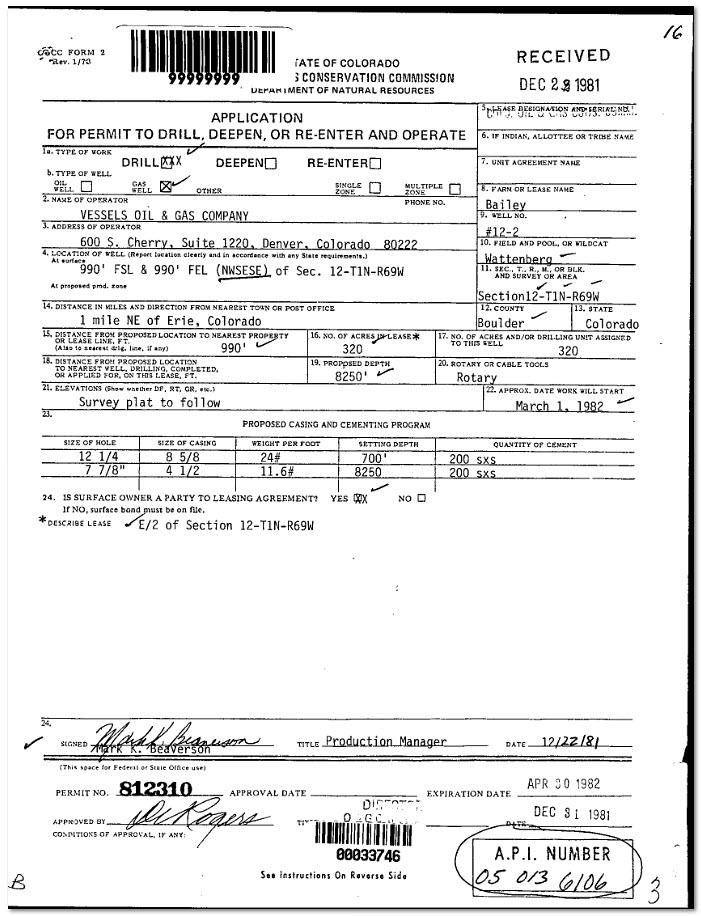
A stunning, but very common case of oil and gas courtesy brought to you by Encana Oil & Gas. In Erie, Colorado, a city park has a plugged and abandoned natural gas well under the surface where children play. Hundreds of homes surround the park where the abandoned well is located with some homes as close as 100 feet away.

The accuracy of this once producing natural gas well is supported with the official Colorado Oil & Gas Conservation Commission (COGCC) 'Application to Permit to Drill' in December 1981 with its precise location. This well was initially owned by Vessels Oil & Gas Company which later sold the lease to PanCanadian Energy (Encana Oil & Gas). API: 05-013-06106

What kind of gesture is it to cover up an abandoned natural gas well and build a playground on the land? How could the city approve of such a probable danger to the public at large, and the children who play on the property?

Click image to enlarge
(Note the dates of the images)


Abandoned oil & gas wells have historic problems and safety concerns as defined by the COGCC.  A recent case dated Jan 13, 2011 in Florence, Colorado an official report was filed by the COGCC to 'Request emergency funding for explosive levels of thermogenic, wet natural gas into and under occupied residential homes from plugged and abandoned wells.' ORDER NO. 1E-10

Below are snippets from the official COGCC Findings document. LINK

...................................

                               3. Soil gas surveys in portions of said Sections 15 and 16 were done prior to and then again subsequent to the plugging of the orphan well.  These soil gas surveys were funded using Appropriation 076 funds for special environmental projects.  The follow-up surveys indicate that soil gas concentrations around and under residences have not decreased subsequent to the plugging of the orphan well.  Five homes are located over or in close proximity to the gas seeps. 

                        4.  COGCC Southern Colorado Field Inspection Supervisor Mike Leonard identified small circular areas of stressed vegetation in the late fall of 2010 in close proximity to oil well locations interpreted from the 1909 USGS records.  He also determined gas was actively seeping from one of the stressed vegetation areas.  He also determined that explosive levels of methane were present in the shallow soils immediately adjacent to one of the mobile homes in the area. 

                        5.  COGCC Staff propose to investigate and determine the sources of gas seeping in this residential area.  The investigation will include detailed investigations of the gas seeps.  Trenching and excavating will be the primary method used to locate orphaned well bores.   Flux surveys of gas seepage volumes will be done simultaneously with trenching and excavating to better locate the sources of gas and the directions in which the gas is migrating.  Other tools that may be used are magnetometers, ground penetrating radar as well as handheld infrared or other gas leak detector devices.  Sampling and characterization of gases from seeps and oil wells in the area will also be used to better understand sources of the seeps.

                        6.  COGCC Staff also propose to aid the local residents to better ensure immediate safety in their homes by purchasing and installing gas monitoring devices as needed.  Other passive mitigation measures may also be used such as venting of combustible soil gases away from homes and residences. 

                        7.   This project designed to ensure human health safety and welfare has estimated costs and expenditures of $67,000.   As described in Finding No. 1, funds for this project are not available from Appropriation 075 which is used for environmental response or from Appropriation 076 which is used for special environmental projects in this fiscal year.  COGCC staff believes that this project needs to be done as soon as practicable due to the potential risk to human safety posed by gas believed to be leaking from orphaned oil wells in the area. 

..............................

Click images to enlarge


There are approximately 79,000 abandoned oil and gas wells in Colorado.  The question you need to ask yourself is: 'Do I have any abandoned wells near my home?'

All cement wellbores WILL fail over time. It's the nature of things. 


.........................


Saturday, December 8, 2012

Statement on So-Called “Mob Intimidation” of Encana Representative at Boulder County Commissioners’ December 4, 2012 Public Hearing on Oil and Gas Development


Sent anonymously -


The incident involving Ms. Wiedenbeck, a public relations representative of Encana, is being exaggerated, sensationalized, and flat out misrepresented. We have reviewed three videos of the incident and spoken with several witnesses. We are confident any video of the incident will reflect this statement.

Far from being followed in the dark to her car by a mob, Ms. Wiedenbeck was escorted from the County Courthouse one block to her car by a Boulder police officer and two Boulder County security guards. Four or five residents followed Ms. Wiedenbeck and heckled her with statements like "it's not okay to poison our children."  At no time was Ms. Wiedenbeck physically threatened or personally attacked. Nobody pounded on the windows of her car or blocked it. 

One of the hecklers was a father whose family is literally being poisoned by Encana. Emotions were running understandably hot. This family lives in Boulder County, invested their savings into what they thought would be a bucolic lifestyle, raising children and chickens and growing their own food. They are now living a nightmare.
Encana is drilling all around them and was recently fined for one of their toxic fluid tanks emitting carcinogenic VOCs that were trespassing onto this family's property, into their children's lungs, and contaminating their crops.
Another family in Boulder County had silica sand from a nearby hydraulic fracturing operation, which can lead to the fatal lung disease silicosis when inhaled, blown onto their property, inhaled into their lungs and coating their crops.
The County Commissioners have consistently ignored these family's repeated and documented requests for a meeting!
We find it deplorable that the County Commissioners are sensationalizing the brief ‘heckling’ of the Encana representative while ignoring these family's documented pleas.
The real story here is that residents of Boulder County are being bullied and poisoned by Encana and the County Commissioners are ignoring it. It should be expected that people are going to be telling the truth with the same audacity that gas and oil profiteers are willing to tell their lies.
"If your child's life is threatened, do you stop to ask a politician if it's legal to save your child’s life?" - Julia Butterfly Hill

Wednesday, September 12, 2012

Water shortage pits farmers, drillers against each other


FOX 31 Denver
9/9/2012

LONGMONT, Colo. — Just west of I-25, along Highway 119, about 50 protestors lined up outside Encana Oil and Gas in Longmont. 
Organizers say it was a surprise protest by concerned citizens and farmers about water. The protest lasted about two hours.


Continue reading...

Tuesday, July 31, 2012

Encana Releases Industrial Waste in Waters of the State - Multiple Residents Appear Impacted and Angry about Water Testing


In a nutshell:  A pipeline possibly containing 'toxic' flowback and produced water discharged thousands of gallons of industrial liquid waste into Dry Hollow Creek, in Garfield County, CO and may have affected adjacent landowners  private water wells, a local aquifer and the Colorado River. The industrial waste spill entered Davis Ditch along Dry Hollow Road, near entrance to Arbaney property on 6/16/2012. Water was found by local landowners to have an iridescent and odorous scum that collected in the ditch. Landowners not happy and don’t trust Encana to take water samples of water wells and aquifer. Landowners request third party testing.

CDPHE states: A ruptured 12 inch pipe released approximately 100 barrels (4,200 US Gallons) of treated produced water was discharges into Dry Hollow Creek, which was initially dry. The water did reach the point at which the creek contained water.

ENCANA states: A pipeline containing produced water and flowback water developed a sudden leak at the above location, resulting in ~50 bbls (2,100 US Gallons) of E&P waste water (produced and recycled water) being released into the Davis irrigation ditch, which is a water of the state.

Ditch users downstream of the release reported seeing iridescent and/or odorous scum collect intermittently along the ditch. Ditch users reported that the ditch recharges the aquifer containing their domestic water wells. One downstream ditch user reported that their well is dry in two weeks if there is no water flow in the ditch.

---------->
MY TAKE
<---------

Q: Did toxic liquid industrial waste reach the Colorado River? Encana claims it did not. I request Encana prove their mishap did not affect the Colorado River.

I think Encana made up the word ‘Sudden Leak’ as an alibi or indemnifying statement.  I don’t buy it, but Encana does, from their attorneys.

I want the COGCC and Encana to prove without a doubt that this liquid release was ‘treated produced water’ and show the landowners that it is benign and will not cause any adverse impacts to their land, water and health. There are no publicly available records that I could find to support Encana’s statement.

Q: Why did the Colorado Oil and Gas Conservation Commission remove Uranium from the analyte list to test for?

Q: Why does Encana get to select the third party water testing agency? The landowners appear to not trust Encana and want a professional unbiased test done of their water.

Q: What will Encana do to remediate the land and water?

Q: Will Encana and the landowners engage in a private settlement agreement? A non-disclosure agreement with dollar bills attached to it will most likely happen if the contamination is irreversible.

Q: Did Encana have volumetric gauges to precisely know how much liquid was released? If so, where are the official documents that support your claim?  Encana states exactly ½ the volume of what was initially reported. Why?

Q: If there is a non-disclosure agreement/settlement and the landowners move, the new buyers will never know of the previous industrial waste discharge.  I believe this is irreprehensible!


To the affected landowners: Please do not sign a non-disclosure agreement. The industry has been keeping their chemical contaminations secret for far too long. We need to know everything in order to protect all landowners now and into the future.


 CLICK IMAGE TO ENLARGE


ENCANA OIL AND GAS (USA)
DENVER, COLORADO

Date of Alleged Violation:  6/16/2012
A pipeline containing produced water and flowback water developed a sudden leak at the above location, resulting in ~50 bbls of E&P waste water (produced and recycled water) being released into the Davis irrigation ditch, which is a water of the state. Encana personnel noticed a sudden pressure drop in the line and identified the leak. Encana reported the incident to the CDPHE- incident #2012-0427. Encana filed a verbal report to the COGCC and have submitted a Form 19 Spill Report. Encana pumped water out of the ditch to recover the fluids, repaired the line, and collected soil samples. A complaint (#200353851) was filed with the COGCC by one downstream ditch user regarding possible impacts to their pond and spring. Ditch users downstream of the release reported seeing iridescent and/or odorous scum collect intermittently along the ditch. Ditch users reported that the ditch recharges the aquifer containing their domestic water wells. One downstream ditch user reported that their well is dry in two weeks if there is no water flow in the ditch.


CLICK DOCUMENTS TO ENLARGE


-----------------------------------------------------------------------------------
EMAIL FROM ENCANA


From: Jensen Jr., Charles H.
To: Spry ORourk, Linda
Subject: Pipeline spill GPS coordinates
Date: Monday, June 18, 2012 3:14:13 PM

Hi Linda,

Here are the coordinates fro my GPS at the area of release. I will send you the estimated amount lost
when I get it.

39.46876
-107.65221

Charlie
Charles H. Jensen, Jr., P.G., C.P.G.
EHS Environmental Group/Hydrogeologist/Special Projects
Encana Oil & Gas (USA) Inc.
2717 County 215, Suite 100
Parachute, CO 81635
(970) 285-2735 office
(970) 309-1022 mobile
(970) 285 2705 fax
charles.jensen@encana.com

OFFICIAL EMAIL FROM COGCC TO ENCANA- LINK

-------------------------------------------------------------------------------------------------------------------

EMAIL TO ENCANA FROM COGCC


From: Spry ORourk, Linda [mailto:Linda.SpryORourk@state.co.us]
Sent: Tuesday, July 03, 2012 9:26 AM
To: Friesen, Kathy; Jensen Jr., Charles H.
Cc: Fischer, Alex; Spray, Karen
Subject: Dry Hollow Pipeline release water well sampling

Kathy and Charlie,

I received two calls yesterday from landowners who apparently spoke with Charlie about the resampling of their wells. Both Mr. Guthrie and Mr. Schultz expressed grave concerns to me about Encana sampling their water wells. Their concerns are not about having the wells tested, but they expressed a desire for a third party contractor to be the entity actually conducting the sampling. Both told me they didn’t mind if Encana got a sample also, but that they would have no faith in the results of a sample if Encana personnel actually collected the sample. Mr. Guthrie especially seemed pretty upset and angry at the concept that I would ‘allow’ Encana personnel to continue the sampling that the COGCC initiated relative to this spill.

I tried to explain that our NOAV requires the operator to burden the cost of sampling after a release and that the COGCC would be monitoring the situation relative to this release and sampling data closely. This information did not really appease either landowner. Mr. Guthrie is vowing to stir everyone on the Davis Ditch up so they call in complaints to everyone they can if Encana personnel conduct the sampling.
So, consider this a formal request for Encana to very strongly consider having their consultant continue the contacts with these landowners and actually conduct the sampling. It appeared to me from conversations with these folks that they would be comfortable with a third party sampling their wells. I also found out from the Schultz that their schedule is not conducive to sample collection from their well before the NOAV abatement date of July 10, 2012. Apparently they have scheduled with Encana for July 13, 2012 to have their well sampled. Because the Schultz well sampling schedule is landowner-driven, an exception to the schedule for collecting the repeat samples is approved for this landowner.

Please let me know if Encana is willing to have a third party conduct this sampling, because I expect to be speaking with Mr. Guthrie again and owe the Schultz’s a call back as well.

Thanks for your cooperation.

Linda Spry O'Rourke
Environmental Protection Specialist, Northwest Region
Colorado Oil & Gas Conservation Commission
707 Wapiti Court
Suite 204
Rifle, CO 81650
(970) 625-2497 Office
(970) 625-5682 Fax
(970) 309-3356 Cellular


Notice of Alleged Violation – Documents

File Size (KB)
53

1061
638


File Size (KB)
8
342
8
8
14
17

99
1061
638


TELEPHONE NOTES – JANICE HUNT

6/18/2012 10:45am

Linda Spry O’Rourke called Janice Hunt. Janice had contacted Margaret Ash Sunday 6/17/2012.
Janice reported that she lives about 2.7 miles up Dry Hollow and that Tim Guthrie had called Sunday to report the leak of produced water into the Davis Ditch. Janice told me that Tim lives about 6 miles up Dry Hollow and had been doing day and noticed no water in the ditch so followed it up toward the headgate. She reported that he found pump trucks at the pie leak recovering what was called ‘Recycled water”. The ditch water was shut off while pumping occurred. Janice reported that tim was worried about his well and if it was contaminated. Janice doesn’t have a well, but had a spring fed by the creek/ditch. She reports she is on a mesa and it’s 125 feet down to the creek. She has a cistern and a pond that has more water than expected. She is not letting horses drink or dogs swim in the pond.

She has an RO system on the drinking water system. Janice reported that the news paper carried a story on the release.

I told Janice that the COGCC would sample her pond and spring to check for impacts from the pipeline release.


Data Compiled by: Shane Davis
Source: COGCC

Please Donate Today!