Showing posts with label Encana Oil and Gas. Show all posts

Tuesday, July 30, 2013

Thanks Encana Oil & Gas for the Abandoned Well Under our City Park! Courtesy Matters...

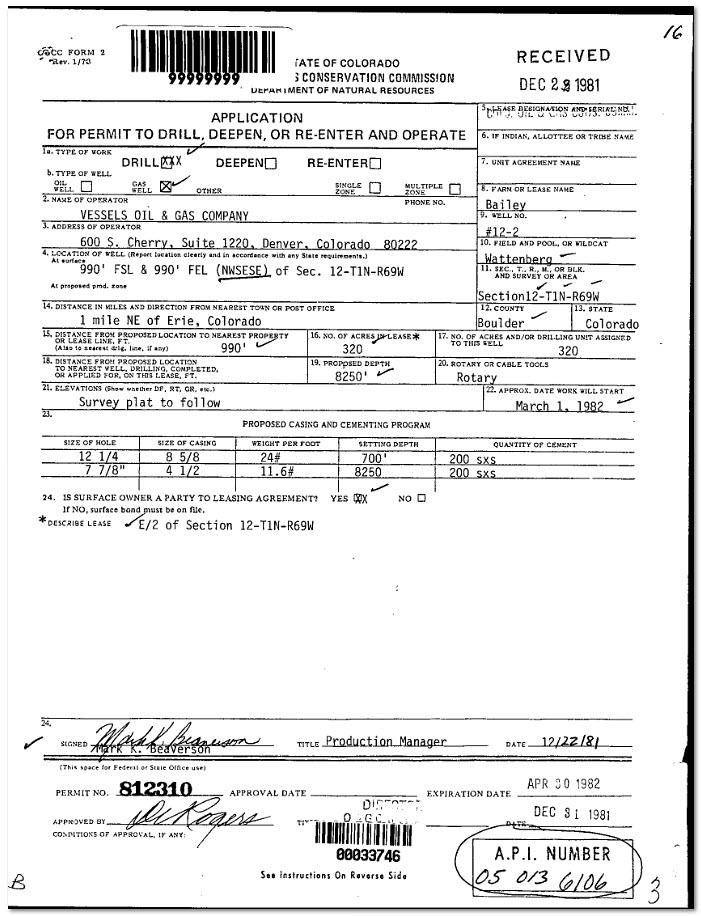
A stunning, but very common case of oil and gas courtesy brought to you by Encana Oil & Gas. In Erie, Colorado, a city park has a plugged and abandoned natural gas well under the surface where children play. Hundreds of homes surround the park where the abandoned well is located with some homes as close as 100 feet away.

The accuracy of this once producing natural gas well is supported with the official Colorado Oil & Gas Conservation Commission (COGCC) 'Application to Permit to Drill' in December 1981 with its precise location. This well was initially owned by Vessels Oil & Gas Company which later sold the lease to PanCanadian Energy (Encana Oil & Gas). API: 05-013-06106

What kind of gesture is it to cover up an abandoned natural gas well and build a playground on the land? How could the city approve of such a probable danger to the public at large, and the children who play on the property?

Click image to enlarge
(Note the dates of the images)


Abandoned oil & gas wells have historic problems and safety concerns as defined by the COGCC.  A recent case dated Jan 13, 2011 in Florence, Colorado an official report was filed by the COGCC to 'Request emergency funding for explosive levels of thermogenic, wet natural gas into and under occupied residential homes from plugged and abandoned wells.' ORDER NO. 1E-10

Below are snippets from the official COGCC Findings document. LINK

...................................

                               3. Soil gas surveys in portions of said Sections 15 and 16 were done prior to and then again subsequent to the plugging of the orphan well.  These soil gas surveys were funded using Appropriation 076 funds for special environmental projects.  The follow-up surveys indicate that soil gas concentrations around and under residences have not decreased subsequent to the plugging of the orphan well.  Five homes are located over or in close proximity to the gas seeps. 

                        4.  COGCC Southern Colorado Field Inspection Supervisor Mike Leonard identified small circular areas of stressed vegetation in the late fall of 2010 in close proximity to oil well locations interpreted from the 1909 USGS records.  He also determined gas was actively seeping from one of the stressed vegetation areas.  He also determined that explosive levels of methane were present in the shallow soils immediately adjacent to one of the mobile homes in the area. 

                        5.  COGCC Staff propose to investigate and determine the sources of gas seeping in this residential area.  The investigation will include detailed investigations of the gas seeps.  Trenching and excavating will be the primary method used to locate orphaned well bores.   Flux surveys of gas seepage volumes will be done simultaneously with trenching and excavating to better locate the sources of gas and the directions in which the gas is migrating.  Other tools that may be used are magnetometers, ground penetrating radar as well as handheld infrared or other gas leak detector devices.  Sampling and characterization of gases from seeps and oil wells in the area will also be used to better understand sources of the seeps.

                        6.  COGCC Staff also propose to aid the local residents to better ensure immediate safety in their homes by purchasing and installing gas monitoring devices as needed.  Other passive mitigation measures may also be used such as venting of combustible soil gases away from homes and residences. 

                        7.   This project designed to ensure human health safety and welfare has estimated costs and expenditures of $67,000.   As described in Finding No. 1, funds for this project are not available from Appropriation 075 which is used for environmental response or from Appropriation 076 which is used for special environmental projects in this fiscal year.  COGCC staff believes that this project needs to be done as soon as practicable due to the potential risk to human safety posed by gas believed to be leaking from orphaned oil wells in the area. 

..............................

Click images to enlarge


There are approximately 79,000 abandoned oil and gas wells in Colorado.  The question you need to ask yourself is: 'Do I have any abandoned wells near my home?'

All cement wellbores WILL fail over time. It's the nature of things. 


.........................


Saturday, December 8, 2012

Statement on Direct Action at Boulder County Commissioners’ December 4, 2012 Public Hearing on Oil and Gas Development


Sent from HYDRAE
On December 4, 2012, a mom of two toddlers from Lafayette, a dad of two teenage girls from Louisville, a mom of two teenage boys from Boulder and an auntie from Niwot, participated in an act of peaceful direct action at the Boulder County Commissioners’ hearing on oil and gas development.

These upstanding and courageous citizens are so concerned about the impacts of hydraulic fracturing on our health, quality of life, community well-being, this place we call home, our property values, and our children’s future that they accepted the risk of arrest to raise awareness that Boulder County is about to become a sacrifice zone to the oil and gas industry.

We are facing an industry that is run amok, wreaking havoc on our planet, poisoning our children’s very life support systems and decimating communities in which they operate, coupled with a corrupt political system that prioritizes corporate profits over people’s and the planet’s well being. Not only Boulder County, but Colorado, the U.S. and, indeed, the entire planet is under assault from the oil and gas industry. As the industry moves full speed ahead with the fracking boom, people across Colorado, the U.S. and worldwide are organizing to defend themselves and their communities against the abuses of the oil and gas industry.

In the immortal words of Thomas Jefferson, “When injustice becomes law, resistance becomes a duty.” Time and time again throughout our nation’s history, people who stood their ground for justice were mocked and ridiculed only to eventually become celebrated. Sometimes the right thing to do is take a stand against unjust laws. Now is one of those times! With climate change and the poisoning of our life support systems, the urgency has never been more profound.

Community members have participated in the public process as structured by the Boulder County commissioners for the past year. The public’s overwhelming opposition to hydraulic fracturing and pleas to the commissioners to take a stand have fallen on deaf ears. The commissioners say their hands are tied and they must follow state law. Hence, the commissioners directed staff to update the county’s regulations concerning oil and gas extraction.

County staff has been working in collaboration with the oil and gas industry and the state regulatory agency, the Colorado Oil and Gas Conservation Commission (COGCC), tasked with both regulating and promoting oil and gas extraction (a clear conflict or interest) to update the county’s regulations. The County Commissioners are now preparing to lift the moratorium.

The COGCC has failed to prevent or mitigate adverse environmental and human health impacts in accordance with their mission statement. According to an analysis of 1,000 spill reports to the COGCC, 43% of all operator spills in Colorado resulted in groundwater contamination, 57% of all protective berms failed to prevent secondary industrial liquid waste migration, 2.4 billion square feet of surface has been contaminated. In Weld County, from 2003-2012, a combined 1.7 million gallons of toxic water and oil releases were never recovered. The Laramie-Fox Hills Aquifer in Greeley was contaminated with toluene and thermogenic gas by an oil and gas operation in 2009, and the list goes on.

Hydraulic fracturing releases carcinogenic emissions into the air, contaminates ground water and aquifers, and compacts and contaminates the soil. Many scientists believe the methane emissions associated with hydraulic fracturing are worse for global warming than coal.

Communities where hydraulic fracturing takes place are overrun by semi-truck traffic. The industry’s transient worker population leads to pressure on the rental market, drives down vacancies and drives up rates. It is well documented that crime rates increase where these transient worker populations are located. The heavy industrial, toxic process of hydraulic fracturing decreases property values, and there are issues with lenders not wanting to make loans on property with or in proximity to wells, as well as insurance companies not wanting to insure. Costs such as road wear and tear are externalized to the community. Wells must be monitored and maintained into perpetuity, placing the cost on future generations.
Oil and gas extraction is inherently a boom and bust industry, leaving behind environmental and economic ruin.

Hydraulic fracturing enjoys exemptions from many federal level environmental laws, such as the Clean Water Act, the Safe Drinking Water Act, the Clean Air Act, the Comprehensive Environmental Response Compensation and Liability Act (CERCLA), the Resource Conservation and Recovery Act (RCRA), the National Environmental Policy Act (NEPA), and more. You would think that would raise a few…thousand…red flags!

Hydraulic fracturing uses 5-10 million gallons of water per frack, and wells can be fracked multiple times. With the chemicals added and the elements the water interacts with deep inside the earth, including naturally occurring radioactive materials, the water is turned into toxic waste that must be permanently removed from the hydrological cycle. This toxic waste water is deposited into “injection wells” bored into the earth (a whole, horrible topic unto itself). Our planet has a finite amount of fresh water, upon which life depends. Turning it into toxic waste is a crime against humanity.

Hydraulic fracturing is an inherently dangerous, heavy industrial, toxic process with risks that include catastrophic and irremediable damage to the environment and public health. These risks cannot be properly resolved, nor can they be mitigated through regulation. Pursuing regulation, as the commissioners are doing, is sanctioning the poisoning of our air, water and soil, along with the myriad other detrimental impacts of oil and gas extraction, including hydraulic fracturing, to our community. Allowing this to happen in our community (or anywhere) is unconscionable.

The direct action at the December 4 hearing entailed a mic check, a call and response action, whereby somebody reads a prepared statement, broken down into short pieces, and the crowd repeats each piece. Nearly everyone in the packed hearing room participated by repeating the words of those leading the mic check, and it unfolded into a beautiful symbolic action of the people asserting their will in the face of unjust laws and a corrupt political system that prioritizes profit over the well-being of people and the planet. It was a beautiful thing!

The mic check started out: “We are the people of Colorado and Boulder County. We are here to announce that the time has come and gone for you to recognize that hydraulic fracturing cannot be permitted in Boulder County.” The Pledge of Resistance to Continued Hydraulic Fracturing in Colorado (http://tinyurl.com/crx5pxs), which was recently released and has over 1,000 signatures already, was also read as part of the mic check. The Pledge of Resistance is endorsed by world renowned scientists and others. Use the link to see the full list and sign the Pledge.

Some youth who had signed up to read a prepared statement during public comment were inspired to use their statement to lead a mic check of their own. Upon conclusion of their mic check, somebody yelled out “who is going to run the meeting,” as the commissioners had left the room. “We are,” said a 13-year-old boy, and what followed was spontaneous inspiration.

As they sat in the commissioners’ chairs, the boy proclaimed, “we are the future, but we are also the present…and we are fighting for our future.” He went on to say, “we pledge to protect the air, the water, the soil for future generations to come.“ It was a magically symbolic gesture unfolding before us. Imagine if it was our County Commissioners doing the right thing at this critical moment in time and taking a stand in the face of unjust laws and a corrupt political system. The young man went on to say, “alright, everybody who wants to ban fracking, put your hand in the air.” The yays had it! Everyone in the packed hearing room (except for the oil and gas representative, we suspect), put their hands up. The room then erupted with chants of “ban fracking now.”

The commissioners returned to the room and the meeting resumed. Everyone who spoke during public comment, which lasted several hours, spoke in opposition to fracking, save the representative of Encana, a multinational oil and gas corporation that has 56 approved permits to drill and frack wells in Boulder County sitting with the COGCC waiting for the moratorium to be lifted. Encana was recently fined for poisoning Boulder County residents (see attached statement on so-called “mob intimidation”). Up to 1,800 wells could be drilled in unincorporated Boulder County alone, not including wells within municipalities within the county. It would mean the industrialization of Boulder County! There are currently 14 hydraulic fracturing operations taking place in Boulder County, including some on open space.

In the end, the commissioners extended the moratorium until January 24 so they can review the regulations one more time. But there is no such thing as safe and responsible fracking! Each of them made comments that they’d like to revisit the setback regulation, how far a well must be from homes and other inhabited structures. State regulations require a 350’ setback, however there is a loophole for existing wells, some of which are located in people’s backyards. Each of them suggested that perhaps 500’ or 1,000’ would be more appropriate than the state mandated 350’. In suggesting a 500’’ or 1000’ setback, the County Commissioners are committing an egregious breach or trust with the citizens they are sworn to protect.

Commissioner Toor cited “sound science” as the reason he contradicted the will of the people (70% of Boulder County residents oppose GMOs on open space) and voted to increase GMO crops on open space. In a strange turn of events, he is pulling numbers out of thin air, based on no science at all, concerning protecting the public from the health impacts of hydraulic fracturing.

The only health impact assessment of hydraulic fracturing to date was done by the Colorado School of Public Health, under the direction of Dr. Lisa McKenzie. The plug was pulled on the study when the findings began to turn out unfavorable to the oil and gas industry. Governor Cuomo recently cited the findings in that study as the reason he was delaying a decision about hydraulic fracturing in New York. The McKenzie study revealed that people living within ½ mile of a well have a 66% increased chance of developing cancer.

It is unconscionable for the Boulder County Commissioners to mislead the public that they are protecting public health with a 500’ or 1,000’ setback. Those are literally random numbers that are not based on scientific findings. In fact, they fly in the face of the science there is documenting the health impacts of hydraulic fracturing.

To add insult to all this injury, literally, our constitutional rights are being violated.
Article 2, section 3 of our state constitution says, All persons have certain natural, essential and inalienable rights… [including] the right of enjoying and defending their lives and liberties; of acquiring, possessing and protecting property; and of seeking and obtaining their safety and happiness.

Article 15, section 8 states, "the police power of the State shall never be abridged or so construed as to permit corporations to conduct their business in such a manner as to infringe the equal rights of individuals…

It is unconscionable for the Boulder County Commissioners to ignore this litany of abuses and allow this to happen to our community. Everything that makes this a place we love to call home is threatened. Everything! The urgency has never been more profound than now. This is one of those moments in history when it is time to take a stand. 

Part II coming soon...

Tuesday, July 31, 2012

Encana Releases Industrial Waste in Waters of the State - Multiple Residents Appear Impacted and Angry about Water Testing


In a nutshell:  A pipeline possibly containing 'toxic' flowback and produced water discharged thousands of gallons of industrial liquid waste into Dry Hollow Creek, in Garfield County, CO and may have affected adjacent landowners  private water wells, a local aquifer and the Colorado River. The industrial waste spill entered Davis Ditch along Dry Hollow Road, near entrance to Arbaney property on 6/16/2012. Water was found by local landowners to have an iridescent and odorous scum that collected in the ditch. Landowners not happy and don’t trust Encana to take water samples of water wells and aquifer. Landowners request third party testing.

CDPHE states: A ruptured 12 inch pipe released approximately 100 barrels (4,200 US Gallons) of treated produced water was discharges into Dry Hollow Creek, which was initially dry. The water did reach the point at which the creek contained water.

ENCANA states: A pipeline containing produced water and flowback water developed a sudden leak at the above location, resulting in ~50 bbls (2,100 US Gallons) of E&P waste water (produced and recycled water) being released into the Davis irrigation ditch, which is a water of the state.

Ditch users downstream of the release reported seeing iridescent and/or odorous scum collect intermittently along the ditch. Ditch users reported that the ditch recharges the aquifer containing their domestic water wells. One downstream ditch user reported that their well is dry in two weeks if there is no water flow in the ditch.

---------->
MY TAKE
<---------

Q: Did toxic liquid industrial waste reach the Colorado River? Encana claims it did not. I request Encana prove their mishap did not affect the Colorado River.

I think Encana made up the word ‘Sudden Leak’ as an alibi or indemnifying statement.  I don’t buy it, but Encana does, from their attorneys.

I want the COGCC and Encana to prove without a doubt that this liquid release was ‘treated produced water’ and show the landowners that it is benign and will not cause any adverse impacts to their land, water and health. There are no publicly available records that I could find to support Encana’s statement.

Q: Why did the Colorado Oil and Gas Conservation Commission remove Uranium from the analyte list to test for?

Q: Why does Encana get to select the third party water testing agency? The landowners appear to not trust Encana and want a professional unbiased test done of their water.

Q: What will Encana do to remediate the land and water?

Q: Will Encana and the landowners engage in a private settlement agreement? A non-disclosure agreement with dollar bills attached to it will most likely happen if the contamination is irreversible.

Q: Did Encana have volumetric gauges to precisely know how much liquid was released? If so, where are the official documents that support your claim?  Encana states exactly ½ the volume of what was initially reported. Why?

Q: If there is a non-disclosure agreement/settlement and the landowners move, the new buyers will never know of the previous industrial waste discharge.  I believe this is irreprehensible!


To the affected landowners: Please do not sign a non-disclosure agreement. The industry has been keeping their chemical contaminations secret for far too long. We need to know everything in order to protect all landowners now and into the future.


 CLICK IMAGE TO ENLARGE


ENCANA OIL AND GAS (USA)
DENVER, COLORADO

Date of Alleged Violation:  6/16/2012
A pipeline containing produced water and flowback water developed a sudden leak at the above location, resulting in ~50 bbls of E&P waste water (produced and recycled water) being released into the Davis irrigation ditch, which is a water of the state. Encana personnel noticed a sudden pressure drop in the line and identified the leak. Encana reported the incident to the CDPHE- incident #2012-0427. Encana filed a verbal report to the COGCC and have submitted a Form 19 Spill Report. Encana pumped water out of the ditch to recover the fluids, repaired the line, and collected soil samples. A complaint (#200353851) was filed with the COGCC by one downstream ditch user regarding possible impacts to their pond and spring. Ditch users downstream of the release reported seeing iridescent and/or odorous scum collect intermittently along the ditch. Ditch users reported that the ditch recharges the aquifer containing their domestic water wells. One downstream ditch user reported that their well is dry in two weeks if there is no water flow in the ditch.


CLICK DOCUMENTS TO ENLARGE


-----------------------------------------------------------------------------------
EMAIL FROM ENCANA


From: Jensen Jr., Charles H.
To: Spry ORourk, Linda
Subject: Pipeline spill GPS coordinates
Date: Monday, June 18, 2012 3:14:13 PM

Hi Linda,

Here are the coordinates fro my GPS at the area of release. I will send you the estimated amount lost
when I get it.

39.46876
-107.65221

Charlie
Charles H. Jensen, Jr., P.G., C.P.G.
EHS Environmental Group/Hydrogeologist/Special Projects
Encana Oil & Gas (USA) Inc.
2717 County 215, Suite 100
Parachute, CO 81635
(970) 285-2735 office
(970) 309-1022 mobile
(970) 285 2705 fax
charles.jensen@encana.com

OFFICIAL EMAIL FROM COGCC TO ENCANA- LINK

-------------------------------------------------------------------------------------------------------------------

EMAIL TO ENCANA FROM COGCC


From: Spry ORourk, Linda [mailto:Linda.SpryORourk@state.co.us]
Sent: Tuesday, July 03, 2012 9:26 AM
To: Friesen, Kathy; Jensen Jr., Charles H.
Cc: Fischer, Alex; Spray, Karen
Subject: Dry Hollow Pipeline release water well sampling

Kathy and Charlie,

I received two calls yesterday from landowners who apparently spoke with Charlie about the resampling of their wells. Both Mr. Guthrie and Mr. Schultz expressed grave concerns to me about Encana sampling their water wells. Their concerns are not about having the wells tested, but they expressed a desire for a third party contractor to be the entity actually conducting the sampling. Both told me they didn’t mind if Encana got a sample also, but that they would have no faith in the results of a sample if Encana personnel actually collected the sample. Mr. Guthrie especially seemed pretty upset and angry at the concept that I would ‘allow’ Encana personnel to continue the sampling that the COGCC initiated relative to this spill.

I tried to explain that our NOAV requires the operator to burden the cost of sampling after a release and that the COGCC would be monitoring the situation relative to this release and sampling data closely. This information did not really appease either landowner. Mr. Guthrie is vowing to stir everyone on the Davis Ditch up so they call in complaints to everyone they can if Encana personnel conduct the sampling.
So, consider this a formal request for Encana to very strongly consider having their consultant continue the contacts with these landowners and actually conduct the sampling. It appeared to me from conversations with these folks that they would be comfortable with a third party sampling their wells. I also found out from the Schultz that their schedule is not conducive to sample collection from their well before the NOAV abatement date of July 10, 2012. Apparently they have scheduled with Encana for July 13, 2012 to have their well sampled. Because the Schultz well sampling schedule is landowner-driven, an exception to the schedule for collecting the repeat samples is approved for this landowner.

Please let me know if Encana is willing to have a third party conduct this sampling, because I expect to be speaking with Mr. Guthrie again and owe the Schultz’s a call back as well.

Thanks for your cooperation.

Linda Spry O'Rourke
Environmental Protection Specialist, Northwest Region
Colorado Oil & Gas Conservation Commission
707 Wapiti Court
Suite 204
Rifle, CO 81650
(970) 625-2497 Office
(970) 625-5682 Fax
(970) 309-3356 Cellular


Notice of Alleged Violation – Documents

File Size (KB)
53

1061
638


File Size (KB)
8
342
8
8
14
17

99
1061
638


TELEPHONE NOTES – JANICE HUNT

6/18/2012 10:45am

Linda Spry O’Rourke called Janice Hunt. Janice had contacted Margaret Ash Sunday 6/17/2012.
Janice reported that she lives about 2.7 miles up Dry Hollow and that Tim Guthrie had called Sunday to report the leak of produced water into the Davis Ditch. Janice told me that Tim lives about 6 miles up Dry Hollow and had been doing day and noticed no water in the ditch so followed it up toward the headgate. She reported that he found pump trucks at the pie leak recovering what was called ‘Recycled water”. The ditch water was shut off while pumping occurred. Janice reported that tim was worried about his well and if it was contaminated. Janice doesn’t have a well, but had a spring fed by the creek/ditch. She reports she is on a mesa and it’s 125 feet down to the creek. She has a cistern and a pond that has more water than expected. She is not letting horses drink or dogs swim in the pond.

She has an RO system on the drinking water system. Janice reported that the news paper carried a story on the release.

I told Janice that the COGCC would sample her pond and spring to check for impacts from the pipeline release.


Data Compiled by: Shane Davis
Source: COGCC

Please Donate Today!