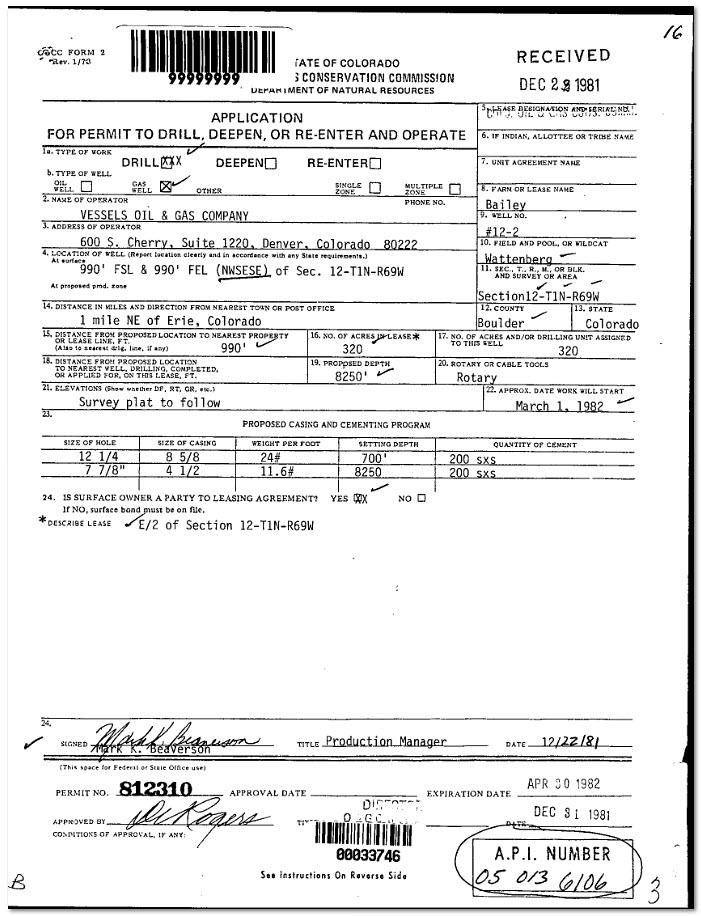
.
BEFORE THE OIL AND GAS CONSERVATION COMMISSION
OF THE STATE OF COLORADO
IN THE MATTER OF EXPENDITURES FROM THE OIL AND GAS ) CAUSE NO. 1E
CONSERVATION AND ENVIRONMENTAL RESPONSE FUND FOR )
THE COLORADO OIL AND GAS CONSERVATION COMMISSION ) ORDER NO. 1E-6
REPORT OF THE COMMISSION
This cause came on for an emergency hearing before the Commission on July 23, 2007, in Suite 801, 1120 Lincoln Street, Denver, Colorado for an order to allow the expenditure of additional funds from the Oil and Gas Conservation and Environmental Response Fund. The Commission held this emergency hearing pursuant to its authority under §34-60-108(3), C.R.S. (2004).
FINDINGS
1. On June 1, 2007 an explosion occurred in the water well pump house associated with the Ben and Melanie Bounds residence located in the NE¼ NW¼ Section 15 Township 29 South, Range 67 West, 6th P.M., in Huerfano County. The explosion damaged the water well pump house.
2. On June 5, 2007 Mr. Bounds contacted John Duran, Colorado Oil and Gas Conservation Commission (COGCC) engineering field inspector for the Raton Basin, about the explosion and on June 6, 2007 John Duran conducted a site visit and confirmed that an explosion had occurred and that gas was venting from the water well.
3. On June 7, 2007 Thomas Melland, Petroglyph Inc. – Raton Basin District Manager, contacted Peter Gintautas COGCC Environmental Protection Specialist (EPS) II for the Raton Basin and informed him that the water well owned by Mr. Coleman and located in Section 10 Township 29 South, Range 67 West, 6th P.M., was possibly venting methane. Peter Gintautas contacted Mr. Coleman and was told that a new pump was going to be installed in the Coleman water well on June 9, 2007 and arrangements were made for Peter Gintautas to collect a water sample immediately after the pump06292 was installed.
4. On June 9, 2007 Peter Gintautas inspected the Bound’s water well and using a combustible gas indicator (CGI), he confirmed that methane was venting from the water well. The CGI meter readings exceeded 100% of the lower explosive limit (LEL) and 99% methane by volume. Peter Gintautas collected a water sample from the water well and submitted it for analysis of dissolved methane, stable isotopes of methane, and inorganic parameters. Dissolved methane was detected at a concentration of 5.6 milligrams per liter (mg/l). The stable isotope results indicated that the methane venting from the Bounds well is of thermogenic origin and is similar to Raton Basin coalbed methane (CBM) gas.
5. On June 9, 2007 Peter Gintautas also inspected the Vince Coleman water well and, using a combustible gas indicator (CGI), he confirmed that methane was venting from the water well. He could not collect a water sample from the Coleman well because there was not a pump in it. The CGI meter readings exceeded 100% of the lower explosive limit (LEL) and 100% methane by volume.
6. On June 9, 2007 Peter Gintautas collected a gas sample from the Rohr 08-01 Well (API 05-055-06292) in the NE¼NE¼ of Section 8 Township 29 South, Range 67 West, 6th P.M., for compositional and stable isotope analyses. Tom Melland, Petroglyph Inc. – Raton Basin District Manager, was present at the time the sample was collected.
7. On June 18, 2007 John Duran received a complaint from Mr. Kent Smith regarding gas in his water well, which is located in the SW¼ NW¼ Section 3 Township 29 South, Range 67 West, 6th P.M..
8. On June 19, 2007 John Duran inspected Mr. Smith’s water well and confirmed that gas was venting from it. Mr. Smith also told John that the well had started venting gas in late May 2007.
9. On June 20, 2007 Peter Gintautas collected a water sample from the Coleman’s water well and submitted it for analysis of dissolved methane, stable isotopes of methane, and inorganic parameters. Dissolved methane was detected at a concentration of 10.0 mg/l. The stable isotope results indicated that the methane venting from the Coleman’s well is of thermogenic origin and is similar to the Raton Basin coalbed methane (CBM) gas. The gas flow rate was also estimated to be as high as 50 thousand cubic feet per day (mcf/d).
10. On June 20, 2007 Peter Gintautas conducted a follow up site inspection of Kent Smith’s water well. The CGI meter readings were 100% methane and one to two parts per million (ppm) hydrogen sulfide. Two other water wells (Mr. Masters’ and Mr. Hopke’s) were inspected and the CGI meter was used to check for the presence of methane. Methane was not detected in either Mr. Masters’ or Mr. Hopke’s water wells.
11. On June 28, 2007 Peter Gintautas and Tom Melland inspected the Lively #10-02 Well (API 05-055-06148) located in NW¼ NE¼ Section 10 Township 29 South, Range 67 West, 6th P.M., which was plugged and abandoned by Petroglyph in 1998. Because of problems experienced during the plugging and abandoning of this well, COGCC staff considered it a possible conduit for gas migrations. At the time of this inspection the well bore was not visible at the surface and areas of stressed or dead vegetation that might indicate gas seepage were not identified.
12. On June 28, 2007 Peter Gintautas inspected the Derowitsch water well and, using a combustible gas indicator (CGI), he confirmed that methane was venting from the water well. The CGI meter a reading at the well head cap vent was 98% methane by volume. The Derowitschs were not home at the time of the inspection, so Peter Gintautas called and told them about the results of his inspection.
13. On July 5, 2007 Buys and Associates, Inc. (B&A) an environmental consulting firm was retained by the COGCC to survey all of the water wells within a 13 square mile area including: Sections 1, 2, 3, 4, 9, 10, 11, 14, and 15 in Township 29 South, Range 67 West, 6th P.M. and Sections 34, 35, and 36 in Township 28 South, Range 67 West, 6th P.M. The water well survey took five (5) days to complete. Eighty four well permits or permit applications were identified in the study area based on data contained in the Division of Water Resources (DWR) database. Of the 84, a number were actually denied permit applications and several were for wells that had not been drilled. Based on the DWR data review, 68 locations were identified and were field checked. Thirty-seven (37) water wells were located and surveyed. Of the 37 surveyed a total of eleven were venting methane. This eleven includes the water wells previously identified as venting gas by Peter Gintautas. Of particular importance is the fact that on June 20, 2007 Peter Gintautas did not detect methane in the Hopke water well, but when B&A returned to this well on July 5, 2007 it was venting methane.
14. On July 9, 2007 Peter Gintautas returned to and inspected the Kent Smith water well and, using a combustible gas indicator (CGI), he confirmed that methane was venting from the water well. He collected a water sample from the Smith’s water well and submitted it for analysis of dissolved methane, stable isotopes of methane, and inorganic parameters. The stable isotope results indicated that the methane venting from the Smith’s well is of thermogenic origin and is similar to Raton Basin coalbed methane (CBM) gas.
15. On July 9, 2007 Peter Gintautas inspected the Angely water well. The well was being pumped and the sanitary well cap had been removed on behalf of the COGCC by a licensed water well contractor. A spark from the electrical switch ignited the methane and caused a small fire that damaged the electrical wiring and box that contained the switch. The fire was extinguished with a fire extinguisher by on-scene personnel. The COGCC has retained a licensed contractor to make the necessary repairs. Class 1 Division 1 (intrinsically safe) electrical components will be used and the electrical box will be moved away from the well head.
16. On July 10, 2007 COGCC staff met with Petroglyph to discuss the emerging issues, the potential threats to public health, safety, and welfare, and the environment from oil and gas operations in the area, and potential mitigation strategies. Petroglyph agreed to provide water to two households, install methane detectors in residences that had methane in their wells, to assist in surveying water wells in the area for methane, and to review the well records for the Lively #10-02 Well (API 05-055-06148).
17. On July 10, 2007 LT Environmental (LTE) on behalf of the COGCC conducted a soil gas survey at Lively #10-02 Well (API 05-055-06148). The survey included a 200 foot by 200 foot area with a 50 foot grid of soil gas probes. Seventeen soil gas measurements were made. Methane was not detected in any of the soil gas probe.
18. On July 10 and 11, 2007 LTE on behalf of the COGCC conducted similar soil gas surveys at two plugged and abandoned well locations: the Golden Cycle 2 Well (API 05-055-06024) and the Golden Cycle 2A Well (API 05-055-06034). The survey included a 200 foot by 200 foot area with a 50 foot grid of soil gas probes. Methane was not detected at either location.
19. On July 11, 2007 LTE on behalf of the COGCC conducted similar soil gas surveys at a gas seep (referred to as #644), which is located in the vicinity of the Bounds residence. The seep was mapped and appears to be associated with an igneous dike. LTE also conducted a soil gas survey around the Bounds house. Methane was detected in the well and in the soil near the well.
20. On July 11, 2007 COGCC staff provided information on managing methane in water well to the La Veta Signature newspaper and Peter Gintautas continued to work with water well owners discussing physical properties of methane and methods that can be used to mitigate methane in water wells.
21. From July 2, 2007 through July 14, 2007 LTE on behalf of the COGCC conducted numerous similar soil gas surveys locations in Huerfano County where gas seeps had been identified by the Phase II Raton Basin Methane Seep Mapping Project – Task 1, which was previously planned and in progress at the time of the discovery of the methane in the eleven water wells.
22. On July 17, 2007 COGCC staff met with Petroglyph to continue discussion of the possible cause and mitigation of the methane in the water wells and gas seeps in Huerfano County.
23. On July 18, 2007 COGCC staff developed a plan for ongoing investigation, testing, and mitigation of the methane in the water wells and gas seeps in Huerfano County and provided this plan to Petroglyph for their review and comment.
24. On July 20, 2007 COGCC staff met with Petroglyph to discuss the proposed investigation, testing, and mitigation plan. Petroglyph agreed to shut in their wells in Huerfano County and immediately initiate the plan (see Attachment 1) for ongoing investigation, testing, and mitigation of the methane in the water wells and gas seeps in Huerfano County.
25. In addition to the investigation, testing, and mitigation plan that will be conducted by Petroglyph, COGCC staff and its contractors will continue to conduct monitoring to ensure that public health, safety, welfare, and the environment are protected and to track changes in methane concentration that may occur. The total estimated cost for this work is One Hundred Eleven Thousand Seven Hundred dollars ($111,700.00). The individual components of this work are described below in Finding 26 through Finding 27.
26. Soil Gas Surveys and Installation of Methane Detection Equipment – LTE will conduct two additional soil gas surveys at the eleven methane seeps identified in Huerfano County and at five plugged and abandoned oil and gas wells and four former oil and gas wells that have been converted to water wells. LTE will also install methane detection systems at two residences that are located in close proximity to a gas seep in NE¼SW¼ Section 16 Township 28 South, Range 66 West, 6th P.M.. The estimated cost for this work is Seventy Five Thousand Three Hundred dollars ($75,300.00).
27. Water Well Survey – The 37 water wells will be surveyed for methane four additional times, beginning on July 23, 2007 and then on a weekly basis. COGCC staff will evaluate the need for additional monitoring as this project progresses. The estimated cost for this work is Thirty Six Thousand Four Hundred dollars ($36,400.00).
28. The facts set forth in the foregoing paragraphs Finding No. 1 through Finding No. 27 are the reasons that the Commission finds the immediate issuance of this emergency order is imperative for the preservation of public health and safety and that observance of the requirements for notice and hearing pursuant to §§24-4-105 or 34-60-108(2), C.R.S. (2004) would be contrary to the public interest.
23. The COGCC was appropriated Three Hundred Twelve Thousand Thirty Three Dollars ($312,033) in fiscal year 2007-08 for the Environmental Assistance and Complaint Resolution line item. These funds are regularly expended throughout the fiscal year, July 1 through June 30, on environmental projects to investigate, prevent, monitor, or mitigate conditions that threaten to cause, or that actually cause, a significant adverse environmental impact on any air, water, soil, or biological resource and to investigate alleged violations of any provision of Title 34 Article 60 C.R.S., any rule, or order of the Commission, or any permit where the alleged violation threatens to cause or actually causes a significant adverse environmental impact. If the funds required to continue the health and safety monitoring for this investigation and mitigation project were taken from the Environmental Assistance and Complaint Resolution line item, then an insufficient balance would be left to fund the anticipated activities associated with the investigations of future allegations of significant adverse impacts to public health, safety, and welfare from oil and gas activities and other environmental projects throughout the state for the remainder of FY 2007-08. A more appropriate source of funding is the Emergency Response line item, which was established by the legislature for the first time in fiscal year 2006-07. This line item gives the COGCC access to One Million Five Hundred Thousand dollars ($1,500,000) from the Oil and Gas Conservation and Environmental Response fund for the investigation, prevention, monitoring, and mitigation of circumstances which are caused by or are alleged to be associated with oil and gas activities and which call for immediate action by the Oil and Gas Conservation Commission. An emergency creates a threat to public health, safety, or welfare or to the environment as proclaimed by the Oil and Gas Conservation Commission Director and approved by order of the Oil and Gas Conservation Commission.
24. The total estimated cost for the different aspects of the health and safety monitoring for this investigation and mitigation project is One Hundred Eleven Thousand Seven Hundred Fifty dollars ($111,700.00). In accordance with §34-60-124(7), C.R.S., the Commission should authorize the expenditure of One Hundred Eleven Thousand Seven Hundred Fifty dollars ($111,700.00) from the One Million Five Hundred Thousand dollars ($1,500,000) Emergency Response line item for the health and safety monitoring of the lingering impacts associated with methane seepage in the area.
ORDER
NOW, THEREFORE IT IS ORDERED, that in accordance with §34-60-124(7), C.R.S., the Colorado Oil and Gas Conservation Commission shall authorize the expenditure of One Hundred Eleven Thousand Seven Hundred Fifty dollars ($111,700.00) from the One Million Five Hundred Thousand dollars ($1,500,000) Emergency Response line item the health and safety monitoring of the lingering impacts associated with methane seepage in the area.
IT IS FURTHER ORDERED, that the provisions contained in the above order shall become effective forthwith.
IT IS FURTHER ORDERED, that the Commission expressly reserves its right, after notice and hearing, to alter, amend, or repeal any and/or all of the above orders.
IT IS FURTHER ORDERED, that under the State Administrative Procedure Act the Commission considers this order to be final agency action for purposes of judicial review within thirty (30) days after the date this order is mailed by the Commission.
IT IS FURTHER ORDERED, that an application for reconsideration by the Commission of this order is not required prior to the filing for judicial review.
ENTERED this day of July, 2007, as of July 23, 2007.
OIL AND GAS CONSERVATION COMMISSION
OF THE STATE OF COLORADO
By Patricia C. Beaver, Secretary
Dated at Suite 801
1120 Lincoln St.
Denver, Colorado 80203
July 23, 2007
LATEST ON INSPECTIONS ON:Rohr 08-01 Well
| You requested : | Inspection Information |
| API Number: | 05-055-06292 |
| New Inspection Search Results - 6 record(s) returned. |
|---|
Inspection
Date | Doc # | Location ID | Insp.
API # | Insp.
Status | Overall
Inspection Status | Overall I.R.
Pass/Fail | Overall F.R.
Pass/Fail | Violation
(Y/N) |
|---|
| 03/02/2012 | 659400306 | 324570 | 055-06292 | | Unsatisfactory | | | N |
| 03/02/2012 | 659400306 | 324570 | 055-06292 | PA | Unsatisfactory | | | N |
| 11/15/2011 | 659400041 | 324570 | 055-06292 | | Unsatisfactory | | Fail | N |
| 11/15/2011 | 659400041 | 324570 | 055-06292 | PA | Unsatisfactory | | Fail | N |
| 11/09/2011 | 659400035 | 324570 | 055-06292 | | Unsatisfactory | | Fail | N |
| 11/09/2011 | 659400035 | 324570 | 055-06292 | PA | Unsatisfactory | | Fail | N |
Data compiled by: Shane Davis
Source: COGCC